No. 1 — The Guest Who Drew Us
November 17th
It was November 17th. I know this because someone else wrote it down — definitely not me, since my own system for tracking dates is roughly “vibes.”
NOV 17 — Namcheonmaru, Jeonju. Small, neat handwriting in the corner of a sketchbook page, the kind of note people make when they’re hopping between cities fast enough that the days start blurring into one regrettable smear.
I don’t remember how they walked in. Two people, speaking Spanish, with the relaxed posture of travelers who’d already solved Korea’s basics: ordering, chopsticks, the kiosk. They sat down, looked at the menu, ordered bibimbap, and had absolutely no idea what they were in for.
The bibimbap arrives in a yugi bowl, traditional Korean bronzeware, deceptively heavy, as if it’s been quietly lifting weights. The sauce isn’t gochujang, which trips up nearly everyone expecting red and spicy. Ours is soy-based, aged over a decade, dark and quiet in a way that confuses people who came prepared for a fight. These two stirred with real commitment and got nowhere, so I leaned over and did it myself, the way you’d quietly take the wheel from someone about to hit the curb.
They ate. At some point, without my noticing, one of them traded chopsticks for a pencil.
She showed me the drawing before they left. The restaurant entrance, drawn straight on — the ordering kiosk to the right, the little plant beside it I’ve been meaning to repot since roughly the Joseon dynasty as well. The tiled roofs of the village framed neatly in the doorway. And in the middle, holding a bowl with both hands: me, apparently, in a flower-print apron and a hanbok top with a bow at the collar, checkered trousers, cloth shoes.
Smiling, which felt generous of her.
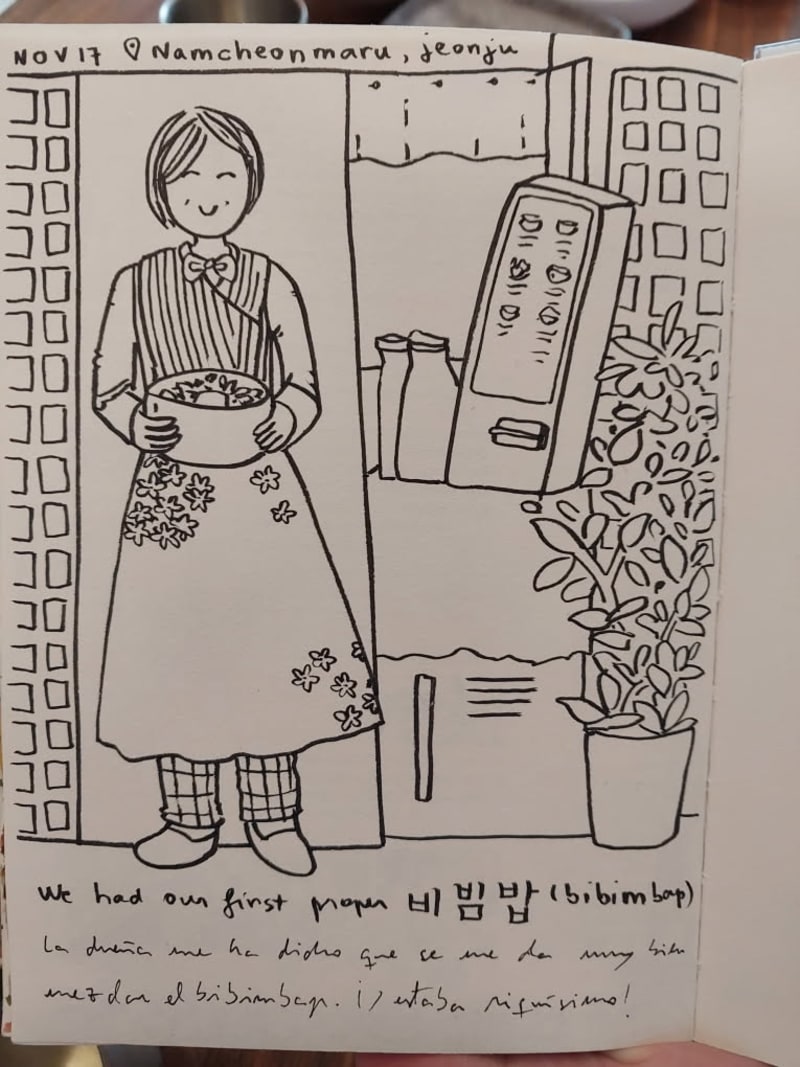
I stared at it longer than is socially acceptable for staring at your own face. A photograph is over before you’ve had time to arrange your features. A drawing means someone actually sat there and looked at you — decided where your hands went, got the apron pattern right, and generously gave you better posture than you probably had in real life.
Underneath, she’d written it in two languages. English first: We had our first proper 비빔밥 (bibimbap). Then Spanish: La dueña me ha dicho que se me da muy bien mezclar el bibimbap. ¡Estaba riquísimo! — roughly, “the owner told me I’m great at mixing bibimbap.”
I did mix it. She just watched. But I’ll allow the credit — anyone willing to draw my apron from memory has earned a small lie.