No. 1 — The Guest Who Drew Us

November 17th

It was November 17th. I know this because someone else wrote it down — definitely not me, since my own system for tracking dates is roughly “vibes.”

NOV 17 — Namcheonmaru, Jeonju. Small, neat handwriting in the corner of a sketchbook page, the kind of note people make when they’re hopping between cities fast enough that the days start blurring into one regrettable smear.

I don’t remember how they walked in. Two people, speaking Spanish, with the relaxed posture of travelers who’d already solved Korea’s basics: ordering, chopsticks, the kiosk. They sat down, looked at the menu, ordered bibimbap, and had absolutely no idea what they were in for.

The bibimbap arrives in a yugi bowl, traditional Korean bronzeware, deceptively heavy, as if it’s been quietly lifting weights. The sauce isn’t gochujang, which trips up nearly everyone expecting red and spicy. Ours is soy-based, aged over a decade, dark and quiet in a way that confuses people who came prepared for a fight. These two stirred with real commitment and got nowhere, so I leaned over and did it myself, the way you’d quietly take the wheel from someone about to hit the curb.

They ate. At some point, without my noticing, one of them traded chopsticks for a pencil.

She showed me the drawing before they left. The restaurant entrance, drawn straight on — the ordering kiosk to the right, the little plant beside it I’ve been meaning to repot since roughly the Joseon dynasty as well. The tiled roofs of the village framed neatly in the doorway. And in the middle, holding a bowl with both hands: me, apparently, in a flower-print apron and a hanbok top with a bow at the collar, checkered trousers, cloth shoes.

Smiling, which felt generous of her.

A traveler's ink illustration of Namcheonmaru
NOV 17 — a photo of her sketchbook, the only thing that stayed.

I stared at it longer than is socially acceptable for staring at your own face. A photograph is over before you’ve had time to arrange your features. A drawing means someone actually sat there and looked at you — decided where your hands went, got the apron pattern right, and generously gave you better posture than you probably had in real life.

Underneath, she’d written it in two languages. English first: We had our first proper 비빔밥 (bibimbap). Then Spanish: La dueña me ha dicho que se me da muy bien mezclar el bibimbap. ¡Estaba riquísimo! — roughly, “the owner told me I’m great at mixing bibimbap.”

I did mix it. She just watched. But I’ll allow the credit — anyone willing to draw my apron from memory has earned a small lie.

No. 2 — The White Chair at Haruilgi

June 2nd

Some mornings deserve no itinerary at all, and today I handed mine exactly that — nothing.

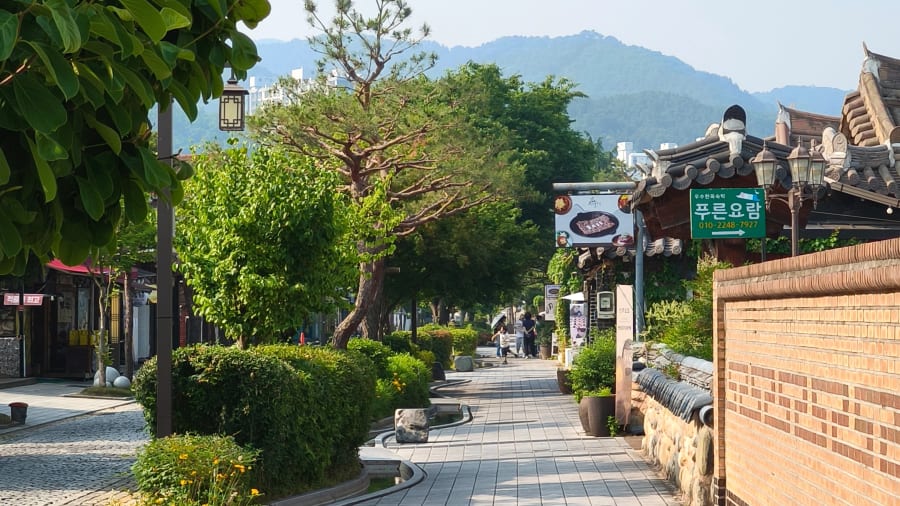
I wandered through Jeonju Hanok Village like a tourist who’d lost her map and decided against finding it. Whichever alley looked more promising won. The stone paths still held onto last night’s cool air, and the roof tiles caught the kind of morning light that makes everyone’s photographs look better than their actual mornings.

That is roughly how I ended up in front of Haruilgi.

It sits on the corner of a narrow, ivy-strangled alley — a clean white wall under a dark, sloping roof, a wooden sign reading “Daily Diary,” and a small plaque proudly stating 1938, as if daring passersby to feel insufficiently historic by comparison. A bicycle leaned beneath the window, rusted in a way that looked almost deliberate, like a prop nobody had the heart to remove.

Nothing about the storefront tried particularly hard. That’s probably why it worked.

Vintage storefront of Haruilgi shop in Jeonju Hanok Village with a faded bicycle
The vintage storefront of Haruilgi, not trying especially hard since 1938.

Inside, white linen shirts hung in rows, lace covered the little tables, and the teacups on the shelves looked like they’d settled into their spots decades ago with no intention of being useful again. The whole place had given up selling things and settled for simply continuing to exist.

Just outside the window, hydrangeas were having a moment — pale blue, dusty violet, the occasional defiant green, bunched up against the stone wall like they’d arrived early to a party. Beside them sat a single white wooden chair, doing the one thing chairs are designed for - a thing almost nobody in this town actually does: nothing.

A single white wooden chair next to blooming hydrangeas in a quiet alley of Jeonju Hanok Village
Unoccupied, for now.

A traveler discovered this almost immediately. He set down a canvas bag roughly the size of a household appliance, lowered himself into the chair, and proceeded to do absolutely nothing with real conviction. No phone, no map, no photographs — just sitting, watching the alley the way the alley was, presumably, watching him.

Eventually he stood, hoisted the appliance back onto his shoulder, and wandered off, leaving the chair to its factory setting: empty, hydrangea-adjacent, faintly heroic.

I caught myself staring at it for longer than is strictly appropriate for furniture.

A day of walking does its damage quietly — sore feet, overpacked bags, the low-grade dread that something better is happening two streets over. The chair made no announcements about any of this. No sign, no suggestion, no opinion on your itinerary. It just sat there, conveniently shaped like a solution.

If you ever wander past Haruilgi and your legs file a formal complaint, look for the hydrangeas by the window. The chair, last I checked, was still unemployed.

No. 3 — The Ticket That Never Left

Some corners of a city never got the memo about time passing.

One afternoon in early spring, I wandered through Jeonju Hanok Village with no plan at all — historically how my best decisions happen, and several of my worst. The rooflines curved against a pale sky. Tourists drifted past with coffee cups, deep in debate about lunch. A wind bell clinked somewhere, doing its one job.

Afternoon street in Jeonju Hanok Village

I’ve lived near this village most of my life, which means I’ve watched it slowly remodel itself while I did the same, somewhat less elegantly. Shops changed hands. Roofs got patched. I did not get patched — I just picked up a few extra creaks and an increasingly opinionated set of knees.

Lately I notice time more than I used to. Not with despair, more the way you notice a friend’s hair has gone gray and remember, with a small jolt, that yours probably has too. You just can’t see the back of your own head.

A sign reading Dongmun Used Book Library pulled me off the main lane, mostly to escape the ongoing lunch negotiations outside, so I went in.

The place smelled less like the dusty bookstores of my twenties and more like dried leaves, an old wooden drawer, paper that had been quietly minding its business for decades. Tidy shelves, soft afternoon light, someone clearly fonder of this place than the job description requires.

With no intention whatsoever, my hand landed on a copy of Forgiveness by the Dalai Lama. I’d like to claim I chose it as a deliberate act of self-improvement, but honestly it was just the nearest spine. The cover had gone soft at the corners. The pages had tanned the particular yellow that only comes from sitting in sunlight, unread, for a very long time.

I opened it. Something slipped out and landed in my palm.

A bus ticket. Faded edges, sharp print. 2004.09.26.

A 2004 bus ticket found inside a book

More than twenty years old, and somehow more legible than my own handwriting. Outside this room, two decades had rearranged entire neighborhoods — buildings demolished, infants grown into adults with mortgages and opinions, governments come and gone. This little rectangle hadn’t budged an inch. As far as it was concerned, the bus was still five minutes out.

I pictured the previous owner — reading a few pages at the terminal, tucking the ticket in as a bookmark when the bus was finally called, then simply leaving. Onto the bus, into whatever came next, never once circling back for either book or ticket. The book eventually wandered its way to a shelf in Jeonju and sat there, presumably bored, for two decades, until I came along and disturbed the peace.

The joke, really, was the book it had picked to hide in. A ticket marking the exact spot where someone walked away clean, tucked inside a book called Forgiveness — found by someone who has kept several decade-old grudges in considerably better condition than this ticket.

Mine are the verbal kind. A comment from 2011 I can still recite with the original intonation. A friendship that ended right around the time smartphones got good, certain lines from that argument still on standby, ready to perform on command. I wasn’t sitting at any bus terminal. I was just keeping a drawer of old tickets, mint condition, going nowhere, on principle.

I left the ticket where I found it. Twenty years of minding its own business seemed worth respecting, so I slipped it back between the pages and returned the book to its shelf, for whichever future stranger fancies a heavier read than they bargained for.

Outside, the village hadn’t moved an inch — same roofs, same tourists, same unresolved lunch argument. I walked off slightly lighter, having apparently set down some unspecified amount of luggage I hadn’t realized I was still carrying.

Mostly, though, I was just relieved I hadn’t been the one who left that ticket behind in the first place. Twenty years is a long time to keep a bus waiting.

No. 4 — The Unnamed, Simply Being

The alarm goes off at 7:47, which is either disciplined or deeply embarrassing depending on who’s asking. Outside, the Hanok Village is already warming under a clear June morning — early light catching the curved roof tiles, a cat crossing an empty lane with the confidence of someone who has never once been late for anything. A shopkeeper somewhere slides open a wooden door. Nobody here seems in any particular hurry, including, apparently, the morning itself.

A peaceful morning commute path through the quiet streets of Jeonju Hanok Village

I was walking the familiar path toward the bridge when I stopped, mostly because two magpies had set up what looked like a meeting at the entrance, and I didn’t want to interrupt.

They sat there doing the brisk, suspicious head-turns birds are so good at, clocking everyone who passed like a pair of unimpressed security guards. They noticed me. They did not seem to care.

Two magpies resting at the entrance of Namcheon Bridge in the morning light

By the time I’d cleared security, the roses were waiting, fully aware of their own importance. They’d arrived about two weeks ago, and the whole neighborhood has been talking about it since — on the bus, on every other phone screen, in the tone usually reserved for celebrity sightings. The roses have bloomed. Deep, theatrical red, lining the path like they’d been booked for the role months in advance. Every poem ever written about roses seems to have been composed specifically to flatter these.

Deep red June roses blooming proudly along a narrow walking path

A little further along, where the stone pavement stops being photogenic, something else was blooming with none of the publicity. A small purple flower — or possibly the particular blue that only happens once sunlight gets involved — was growing straight out of a crack in the ground, stem about as thick as dental floss, face turned up to the morning as if it hadn’t gotten the memo that nobody was watching. A woman in running shoes stepped directly over it without so much as a glance down.

A resilient, nameless small purple flower growing from a crack in the stone pavement

By any honest measure, it was doing precisely what the roses were doing — catching the same light, running on the same morning, putting in identical effort for an audience of absolutely no one. The crack in the pavement and the formal flower bed were, professionally speaking, working the same shift.

Nobody’s gotten around to naming this one, which mostly just means nobody’s had the chance to be impressed by it on purpose. The rose got there first — got a name, a season, several centuries of flattering verse, an entire marketing department. The flower in the crack got a crack. Functionally, they’re tied.

I thought about this longer than the flower probably deserved, partly because I, too, walk around with a business card full of official-sounding words, and I’m not entirely convinced those words are doing more work than this flower’s complete lack of any.

The magpies, for their part, had no opinions on any of this. They were at the bridge because that’s where the bridge happened to be. No further explanation requested or offered.

The lanes filled in slowly the way they always do here — a shop owner setting out a small display, two older men trading slow conversation on a bench by the stream, the sun finally clearing the rooflines enough to make everything look intentional.

I reached my own street, key already out of my pocket. Behind me, the magpies had presumably relocated to go harass someone else’s morning.

The shop door opened, and the light came in with me — the specific kind June does well, landing across the floor and lighting up a small galaxy of dust that had clearly been there the whole time, just waiting for someone to open the door and notice.

No. 5 — Dreaming of 'Arirang' Along the Curve of the Roof Tiles

June 8th

In June, the afternoon light in Jeonju shows up late and overstays its welcome. It lies flat across the entrance of Namcheon Bridge like it’s avoiding rent.

I was doing what everyone does on a slow afternoon — scrolling with no destination — when a headline knocked me sideways: BTS World Tour ‘Arirang’ in Busan. I pictured the stadium for about four seconds — lights, thousands of phones held up, the works. Then, for reasons I can’t fully defend, my brain filed the whole thing under “wrong location” and rerouted itself to Namcheon Bridge instead.

Specifically to Cheongyeonnu, the little pavilion at the bridge’s center, its roof curling up at the corners like it’s permanently mid-shrug. Jeonjucheon ran along underneath, doing what rivers do, which is mostly just continuing.

The elegant curved roof tiles of Cheongyeonnu Pavilion on Namcheon Bridge against the June sky
The pavilion at the center of Namcheon Bridge, mid-shrug since the Joseon dynasty.

Across the bridge, the city was doing its evening-commute routine — idling engines, blinking crosswalks, the universal urgency of people who needed to be somewhere five minutes ago. Inside the village, none of that urgency had been invited in. Wooden floors creaked at their own pace. A shop sold rice wine into the early evening air. A cat slept on a warm wall like it held a long-term lease on the spot.

My daydream, lacking a stadium-sized budget, downgraded considerably. No pyrotechnics, no synchronized lights, no fifty thousand phone screens held aloft. Just somebody — no name attached, no headline required — sitting on the wooden floor of Cheongyeonnu with one guitar and whatever voice they had left by the end of a June afternoon, singing Arirang to absolutely nobody in particular.

A peaceful view of Namcheon Bridge from afar, showing the scale of the structure
No back row here. The song wouldn't have far to go.

Arirang doesn’t really need an audience, or even a singer with much technique. It’s been sung by people who couldn’t locate the source of their own sadness and just let it leave through their mouth instead. Nobody can say with certainty who wrote it first, which somehow makes it everyone’s — like a recipe passed down with no original author and several hundred regional variations, all insisting theirs is the correct one.

What I kept circling back to was the sheer distance between a billboard and a bridge. A stadium concert reaches someone in the back row who will never see a face clearly — which is genuinely its own kind of impressive. But the version in my head had no reach at all. The guitar was quiet enough that you’d have had to sit close just to hear it properly. The song wasn’t going anywhere. It would just loiter — around the roof tiles, into the gaps between the stone pavers, through the door of the rice wine shop right as someone happened to step outside.

There’s something almost rude about how small that is, next to a stadium. I liked it anyway.

The oldest versions of Arirang were probably exactly this small — somebody not trying to sound good, just trying to put a feeling down somewhere outside their own chest. Na-reul beorigo gasineun nim-eun — the one who leaves me behind — handed from one mouth to the next without losing much in transit.

As dusk came in, the lanterns along the path lit up one by one, small orange fires behind paper. The June blue didn’t disappear so much as get demoted to a deeper shade — the one Korean calls borasaek, a purple that’s somehow both bright and heavy at once, which feels a little like cheating, color-wise.

I never made it to Busan. I didn’t hear the actual concert. But I sat with my no-budget version of it long enough that it started to feel like something that had really happened — a song crossing a small bridge in the late afternoon, slipping into the water, and continuing downriver well past the point where I could keep track of it.

The calm waters of Jeonjucheon river flowing steadily beside the hanok village
The Jeonjucheon, entirely unbothered by any of this.

The Jeonjucheon did not pause for any of it. It just kept moving, the way it always has, taking whatever the city handed it and letting it go without much ceremony.